
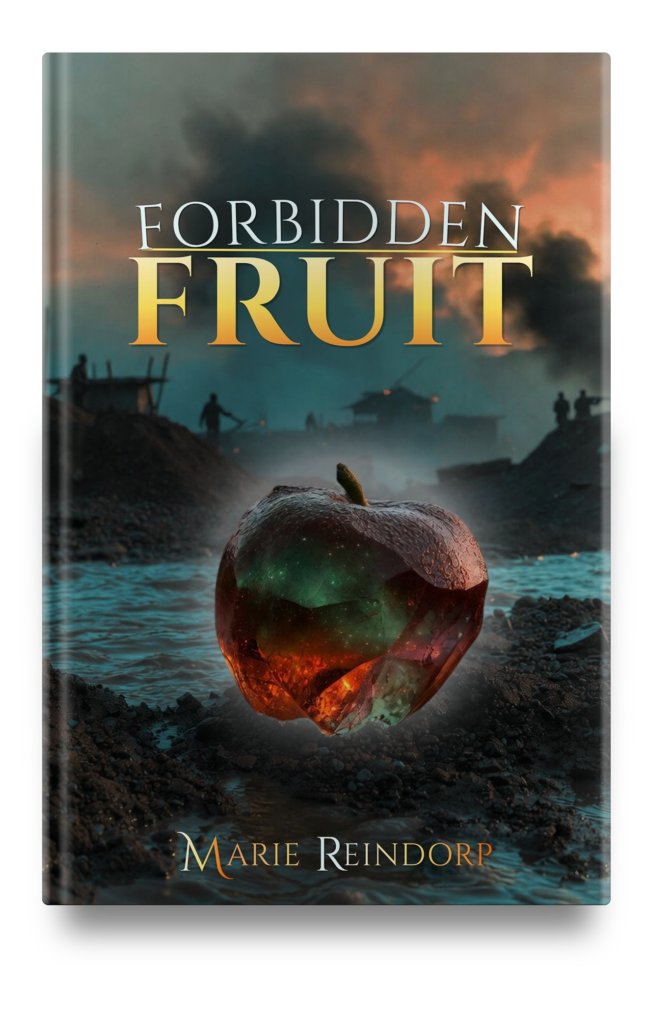
Minning under the glare of the Junta takes its toll on diamond miner JJ Ruffi. When drug -crazy rebels invade the town, JJ must escape with his precious stones. Will he survive the journey?
An African Diamond Mining Story. By Marie Reindorp
Kono, Sierra Leone, West Africa.
On a cool evening along the banks of the Sewa River, JJ Ruffi, one of a handful of white diamond miners left in war-ravaged Sierra Leone, stood on his verandah and sighed. He stroked his unkempt beard and watched the river weave its altered course in a clay-colored haze. The polluted water was once the richest alluvial mining area in the whole of West Africa. But since the Junta seized power of the country and rebels massacred every diamond pit, the river had lost its original shape. Diamonds were no longer found by the bucketful. JJ blamed both the Junta and the rebels for the destruction and felt as if the spirit of the river had died. Mud to mud, carat to carat, he thought. There would be no éncore for diamonds here.
Only in his late thirties lines of gray already appeared on each side of his temples and were advancing into his sandy hair. JJ sighed again and let a moment of melancholy drift through him as he studied the mounds of unwashed gravel dominating the scenery. Afterall, gravel is where diamonds lived: Deep in the river, brought to the surface and piled like hills to be washed one shovel load at a time. Whatever the turmoil of the country JJ was convinced that one shovel of gravel could still be worth an uncountable fortune. But mining under the glare of the Junta escalated the danger for Lebanese foreigners such as himself. His chances of survival grew slimmer each day.
Like heroin, diamonds have no mercy. Addictive and destructive, their hypnotic glitter is lethal. JJ knew what those scintillating gems could do to a man. He’d chased that dream for years. Twice as he began to rake in the rewards of heavy costly mining, rebels attacked his mining pits. His hard work, time and money vaporized into dust after the rebels had finished.
Such was the lure of these sparkling gems, and he too had become intoxicated with diamond fever. He believed the mounds of unwashed gravel he stared at were his. After years of primitive mining, the gravel was all he had to show for his time, money and miserable life. Which is why he stayed in the God-forsaken cesspit. But JJ was not ready to raise the white flag.
Now food was scarce. Not so much as a sweet yam passed through enemy lines, and the entire town, a population of over two hundred thousand, were starving.
At night JJ filled a tumbler with his most precious gems. When he added water and flashed a light on the glass the stones spoke to him. For a time, he even forgot about food. His best stone was a prized D diamond worth over $50,000 American dollars. But lately his stomach didn’t care. For the last three weeks he had survived on peanuts and bananas. His dreams, once filled with visions of wealth and fancy cars, now featured roasted chickens and T-bone steaks.
The time had come to take his diamonds and escape. He could attempt the native route over the Tingi Mountains, but he was not a climber, and the seven peaks would be difficult. Plus, rebels, bandits and Fakirs lurked in that pass. Rebels on that jungle path recently caught a friend of his. The man swallowed his diamonds rather than have them found on his person. The rebels suspected as much. They cut him open to get them. JJ shook with fear. No-way was he going on that jungle path. He decided his only option was by car to the Guinean border and hoped he had enough cash to bribe the guards. He knew he was breaking the law by smuggling diamonds and would be killed if he was caught.
“They will shoot you, Boss,” Amadu, his faithful skinny servant warned JJ when told of his plan. “By foot is better.”
JJ had found Amadu begging on the street a year ago and gave him a room in his home. Orphaned by the war. Amadu now earned his keep by being the housekeeper.
“We will leave by road. Let’s try to get out,” JJ replied, slapping flies from his neck. He felt a responsibility for Amadu’s welfare and wanted to send the teenage man to school in the coming months. Amadu dreamed of going to college. One day he would be an accountant and have a solid future with a wife and children away from war and misery.
Amadu peeled some bananas. “We must go by walking, Boss. Get as much diamonds as you can. Let us go.”
Amadu, like most of the locals, walked everywhere. The natives didn’t trust the speed and safety of moving transport. Centuries of walking had conditioned them to believe cars were unreliable and few had money for fuel. Besides, cars could not climb mountains or ford a river.
JJ munched on peanuts and told him, “I’m not taking a chance going on that jungle path by foot. We will go by car.”
They ventured at night along the only road to the border. The pitted excuse for a road was a dangerous thirty miles, even without contending with the special diamond police that patrolled the area. Amadu leaned forward in his seat as stiff as a piece of wood. His eyes bulging while he scanned the way ahead in silence. The Junta had sectioned the road off into numbered checkpoints. When JJ and Amadu reached number eleven checkpoint, eleven miles from Kono, they bribed the guards with American dollars and passed through. JJ had no luggage, just his passport and his diamonds, which he wrapped in an old handkerchief and pushed into his pocket. As they approached thirty-mile checkpoint JJ relaxed. Almost home free.
A burly soldier with bloated cheeks came to the car and tapped his machine gun on the windowpane. “Where are you going,” he demanded.
JJ wound down the window and the soldier pushed the gun into the car.
“Get out,” the soldier ordered.
JJ opened the car door and stepped out. Sweat poured down his forehead. Then three more soldiers arrived and aimed their machine guns at his chest. If they search me, I’m done for, he thought, as one started to frisk him.
“I’m going to the border,” JJ said. Did I actually think I could escape with diamonds! What was I thinking?
“You can’t cross without a letter of permission from the Secretariat.” The burly soldier said. “Give it to me.” He reached forward with his left arm just as the soldier frisking him got to the waistband of his trousers.
JJ squeezed the handkerchief in his pocket into a ball and patted the perspiration on his forehead with it. He tutted and said, “to reach number thirty-mile checkpoint you must have a letter of permission?” and let a confused expression sweep over his face.
The guard’s eyes narrowed. “You whites know the rules. You must have a letter. This is a direct order from Chairman Koroma.”
Chairman Koroma was the head of the reigning Junta and would sooner hang a diamond smuggler like JJ than give him a free pass.
JJ backed up a couple of paces, smiled and said, “Then I have to go get one.”
The soldier spat and shouted, “empty your pockets.”
A group of soldiers swarmed the car. Amadu’s teeth chattered so loud JJ could hear them from outside the vehicle. One of the soldiers yanked the frail young man from the passenger seat. He cowered over the door, his hands above his head, ready to embrace whatever brutal treatment the soldiers gave him.
JJ wiped his dripping forehead again with his handkerchief and put it back into his pocket. He pulled a wad of cash from his other pocket, handed the money to the guard and said, “leave that man alone.”
The guard snatched the cash, grinned and lifted his machine gun from JJ’s chest.
“Where are his papers?” The soldier towering above Amadu demanded.
JJ slipped back into the car and said, “Amadu, get back inside.” He started the car. “I will get you your letter,” he told the soldiers and backed the car away.
Amadu shook, “Boss, they go kill us,” he said. “Let us go by foot. Let us go now.”
“To walk is impossible,” JJ said. “When the time comes, we’ll leave by car. All we need is the letter from the Secretariat.”
JJ didn’t breathe easily until he stepped once again over the threshold of his house. To be just minutes from freedom then forced to return to hell was more than he could stand. Then there were the bribes to get away and back through the various checkpoints. All his cash was gone. Without money escaping would be much more difficult. He unwrapped his diamonds from his handkerchief and though how ironic that they would only buy him a quicker death.
He considered how to obtain the “letter” knowing that to get it was possible if enough was paid. But JJ was illegal in the country, had been for years, which meant he’d never be able to buy it anyway. Even so there wasn’t money in town to pay for it. No cash, no business, no food. Sierra Leone was under sanctions and JJ’s stomach rumbled with hunger.
Six weeks passed. The supply of peanuts and bananas ceased. Amadu boiled bush yams adding the occasional drop of palm oil. Once they shared a tin of sardines that Amadu stole from somewhere. A nice treat. In the end they ate what everybody else ate: Small swamp fishes that tasted like shit.
JJ lay in bed at night and pondered his escape. Why go to Guinea and not to Freetown he reasoned. He decided to head to the Capital, the opposite way. He had enough diamonds plus he could sell the car. He thought to ruffle his beard with flour to make him look dirty and poor, even crazy. People would think he was a failure. Yes, he must act like a failure. This was hard to do when he had diamonds worth thousands of dollars wrapped in a handkerchief in his pocket.
Shortly after the attempt to leave, the Sierra Leonean army surrounded Kono. JJ made deals with soldiers who had rice by exchanging diamonds, once trading a stone worth six thousand American dollars for two bags of broken Italian rice. But it was risky to travel in the fighting zone as the Junta, and the army raged their war against each other and the rebels. Within days the fighting escalated, and the Secretariat refused to issue letters to leave. Rumors penetrated the town that a rebel attack was imminent. Locals said the rebels would only attack if the whites made a run for it, and the Africans would never leave town if the whites remained. JJ knew he had to swallow his fear and escape.
He camouflaged the car inside a bush on a hill. After filling the tank with petrol he had stored in his lock-up, he packed extra tanks, enough for the two-hundred-mile journey to Freetown. Every day he went alone and ticked over the engine to keep the belts, fluids and batteries working. The ritual inspired him. Instinctively he knew it was his last chance to leave.
JJ stood on his verandah and watched the setting sun splash tangerine rays over the mounds of unwashed gravel. The dirty Sewa River once sparkled under that same sunlight. Now even the roar of the water had dulled. He suddenly felt as if the river was warning him of events to come. A premonition of his own death loomed on the horizon and JJ shivered. He lifted his head and stepped into the kitchen.
“We’re going to have to make our move in the next few days,” JJ said to Amadu. “I’m tired of waiting. The time will come when the rebels will enter Kono. Then we will all be beef. Dead beef.”
“Boss, they will kill everyone on sight. I beg, don’t leave me here.”
“I will never leave you,” JJ said. “We will go to Freetown.”
“No, we must leave to Guinea now, by foot,” Amadu said, a look of dread in his eyes.
JJ thought how his friend had met his death on that bush path by being sliced apart from ear to ear. He shook the image away and said, “not by foot. And not to Guinea. We may have to face death, but we’re not dogs to beg for mercy.” Freetown, Guinea, he didn’t like either choice he faced but he had to make a decision. Time was running out. “We are survivors you and me,” he said as Amadu spooned something from his cooking pot onto a tin plate.
“Boss, why you think like this, “Amadu said as he served up a black shriveled swamp fish. “We are already dead.”
“Then we will die like men,” JJ said, trying to encourage the coward inside him more than his servant. Still his own hidden terror felt like lumps of undercooked yams lodged in his throat. He picked up his glass tumbler of diamonds, but his hands shook as if he had malaria. He lay in bed shivering with fear, praying to God to take his hunger pains away. For comfort he’d look at his diamonds, mesmerized by their glitter and fall asleep with the rat-a-tat-tat of gunfire and screams of torture in his ears.
Swamp fishes disappeared. On the radio JJ heard that rebels were ambushing every car heading for Freetown. Then the Junta began searching every household for stolen diamonds. If they found anyone hording illicit stones, the punishment was death by firing squad.
The Junta search reached his street. Three neighbors met death outside their own front door. JJ said to himself, “shit, I can’t be caught with diamonds on me. I will hide them and come back after the war.” Yes, he decided, when the war was over, he would return, and they’d surely be waiting for him.
But where to hide such treasure was the question? He spent days looking for the right spot until he tripped over a loose tile on the kitchen floor. The green and blue ceramic square had a crack along its edge. He loosened the tile with a metal spatula and dug a hole, six inches by six inches and just as deep. If the Junta searched his house, they would look behind the refrigerator, under the bath perhaps, but they would never think of digging up the kitchen floor.
Late that night JJ put his diamonds into a red velvet jewelry bag and lowered them into the hole. After recementing the tile, he scratched the letter J on the side so that when he returned, he would be able to find his stash. He had just finished gluing when he looked up to see Amadu standing behind him.
“I thought you were asleep,” JJ said and wondered if Amadu had seen him bury the red pouch.
“I hear a mouse in the kitchen, Boss,” Amadu said. “I go for catch it.”
“A mouse! Why would a mouse be in this kitchen, Amadu? For sure not for food.”
JJ lay in bed feeling sad that the stones he had carried around in his pocket for ages were no longer in his possession. His stomach groaned from hunger. After a while a sense of relief came upon him and he relaxed. As he drifted off to sleep grenades and rapid gunfire blasted the street. Diamonds and eating were the least of JJ’s troubles as gangs of drug-crazy rebels, heavily armed, marched into town.
Amadu ran to his boss. “They de cum, Boss,” he screamed. “The rebels are here.”
JJ jumped out of bed and yelled. “Come on, follow me.”
“Where to Boss.”
“Bring one bag. I have already made a plan. Now hurry if you want to live.”
JJ grabbed a bag he had prepared and paced the verandah while he waited for Amadu. The rapport of gunfire increased.
“Amadu, I’m leaving,” JJ screamed as rebels smashed through the front door below.
Amadu appeared. JJ grabbed him by the shoulders and lowered the lean servant over the balcony at the back of the house, then jumped over himself. They legged it through the town amidst gunfire until they miraculously reached the car. JJ sat at the wheel not daring to start the vehicle.
“We will wait till dawn and then drive to Freetown,” JJ said. “We will follow Makeni Road and then head through the main highway.”
“Why no go now,” Amadu asked.
“Because they will be waiting now. At dawn they will be too drunk and stoned to be awake.” JJ smiled at Amadu. “But we will escape or die,” he said, as he pulled a 9mm Tagarif pistol from the glove box. “It’s all or nothing now, Amadu. Are you with me?”
“Yes, Boss.”
A terrific blast startled them. Through the bushes they saw the house they had lived in collapse into a pile of rubble. Another explosion rocked the hill, shifting the car forward. The entire street turned into a pile of bricks and dust. Each heap resembled the other and JJ thought, “My precious stones are lost in the same place from where they came. Gone, buried forever once again below the earth.” He looked at his hands and the dark stained crevices ridged along his fingernails. His diamonds were gone. He could only think about his escape.
At first light JJ released the hand brake. He pushed the vehicle through the bush and down the hill, heading for the checkpoint out of town. The car rolled in neutral and silently glided through the barrier. JJ turned the ignition key and when they finally left the barriers and were fully committed to the road, he clutched the gear into second. The car jumped into action. They were away. By 8 A.M. they reached the outskirts of Freetown and safety.
“Boss, Boss, you save my life,” Amadu said. Then he screamed. “Boss, look your hair!”
In the rising sunlight JJ observed his hair had turned white. He sat in the car shaking when his faithful servant nudged him.
“Boss man, I think you forget something?” Amadu said.
JJ turned to see his red velvet pouch of diamonds dangling from Amadu’s hands as a rumble of thunder rolled across the sky. The thunder was the only warning they had before marble-sized raindrops fell on the roof of the car.
JJ smiled then laughed turning into the crazy man he had thought to pretend to be. He knew that the torrential rain would wash the crumbled street and mounds of gravel by the riverbank back into the Sewa River. The clay-colored mass of water would once again fill with diamonds. Mud to mud. Carat to carat. Éncore!